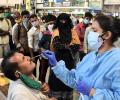
'This year, we know the virus. Last year we didn't know anything about it.' 'The best part is that for the Indian population there has been some amount of cross protection.'

The CM urged all Malayalis to donate one month salary to rebuild the state, where the death toll has now touched 302.
'We have promised to ensure reduced tax rates.'

With an epic battle of billionaires for supremacy in one of the world's most prolific markets and a pandemic-propelled surge in online shopping in the background, India's nearly trillion-dollar retail market is hoping to touch 85 per cent of the pre-COVID business in the first half of the New Year. In a year when the COVID-19 carnage ripped apart the retail business, circa 2020 will best go down for the unravelling of the war between Jeff Bezos, the world's wealthiest man, and richest Indian Mukesh Ambani for pre-eminence in the booming market that is estimated to reach $1.3 trillion by 2025. It all started with Ambani's Reliance Industries agreeing in August to buy assets of the nation's second-largest retailer for Rs 24,713 crore, just a year after Bezos' Amazon purchased an indirect stake in the indebted Future Retail.

PM extended some old schemes and finally said yes to one that was legally mandated for past 2 years.

Banning meat is cruel demonetisation. It is stealing from the poor, nothing less, writes Sunita Narain.

Let us see the problem for what it actually is: Illegal Immigration plain and simple, confined to the northeast with a definite communal slant that poses a national security risk and one that needs to be dealt with firmly and promptly by stringent identification (and deportation), says Vivek Gumaste.

For the first time in its three decade-old history, the country's elite counter-terror force National Security Guard has begun training its commandos in undertaking precision hostage rescue missions in jungles keeping in view emerging Naxalite tactics aimed at capturing high-value targets.
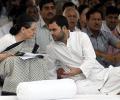
Could this reluctance be tied to the family's projection of themselves as the last bastion of the aam-aadmi's interests? Do they fear that a full disclosure of their not-inconsiderable assets would go against their carefully-cultivated pro-poor image, wonders Saisuresh Sivaswamy.

UV Asset Reconstruction Company Ltd has made the highest bid of Rs 16,000 crore to buy Anil Ambani group's Reliance Communications and Reliance Telecom, which are in the National Company Law Tribunal (NCLT). Last year it was the highest bidder for taking over Aircel's assets for an upfront payment of Rs 150 crore. Surajeet Das Gupta and Dev Chatterjee dig deeper to find out more about this little known company.
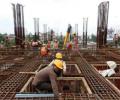
Around 81 per cent of the workers constitute the unorganised sector - devoid of any social security cover and outside the purview of a complex set of labour laws.

Farm loan waivers should not be regarded as expenditure but as incentive and investment, argues B S Raghavan, the distinguished civil servant.
'None of these three countries -- Turkey, Iran or Malaysia -- ever made a hostile move against India to support the Pakistan-based terrorist elements,' notes Ambassador M K Bhadrakumar.

Relations between India and America will always be transactional. It is true that the two countries share common values -- democracy, rule of law, separation of powers, etc, but these have failed to establish a long range, lasting and compatible relationship, says Ambassador C R Gharekhan.
'We're going to campaign across the country to convince more candidates to endorse some/all of these issues -- and hold them to their promises if and when they are elected.'

The report said South Asia is expected to be the fastest-growing region.

Deep down, Katragadda is still that boy who makes as well as sells soap

'The telecom companies are our lifeline now, despite having nearly collapsed under debt because of ill-advised policies.' 'Perhaps our obvious dependence on telecom services will spark well-conceived policies for this sector,' says Shyam Ponappa.
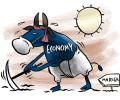
'A proposal to do away with labour laws is not feasible.' 'That's why we wanted to have a dialogue with the states.'

Few readers will remember the socialist utopia of Indira Gandhi when food queues were the norm even for the middle class and tankers supplied water at odd hours of the night twice a week. Is that what you are trying to return us to, dear Congress, asks Jaideep Prabhu

Questions were asked about the recent round of funding in which it raised Rs 50 crore but there was no answer.

Ajit Mishra, vice president, Research, Religare Broking, answers your queries.

Following is the full text of Prime Minister Manmohan Singh's speech at the Central Party School in Beijing on Thursday:
More people will be literate, on the Internet, linked to the national identification scheme and likely to receive electricity, especially from alternative-energy sources.

Former RA&W chief A S Dulat, who served as Atalji's adviser on Kashmir, gives us an insider's glimpse of a prime minister he has hailed as the 'greatest after Nehru'.

India has said the current crisis in Gaza can be resolved through a negotiated political settlement and dialogue remains the "only viable option" to effectively address issues confronting the region and its people.
.jpg)
Modi government has taken some interesting policy decisions in the 100 days since the time he met President Pranab Mukherjee to present his claim as Prime Minister of the world's largest democracy, says Tanmaya Nanda.

With more than one million people affected by the current Ebola outbreak in West Africa, the World Health Organisation has warned that there is "no early end in sight" to the severe health crisis and called for "extraordinary measures" to stop the transmission of the disease.

'The current crisis is one of incomes, driven by poor job growth, agrarian distress and poor investment sentiment,' notes Harsh Pati Singhania, director, JK Organisation.

'... And I don't think it really is that despite a lot going wrong.' 'Naiveté or stupidity or trusting the wrong person, the outcome is the same, which is that the group has gone to trash.' 'I'm not OK with people saying I had a role to play in crooking the system, which is not what I did.'
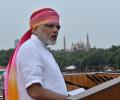
Modi said his government's focus was on adopting the strategy of 'Reform, Perform and Transform'.

Armed with deep customer knowledge, low operational overheads, new funding opportunities and help from online marketplaces, the local brand is turning David to every Goliath that steps into its neighbourhood, says T E Narasimhan.

At this point of time, the requirement of the economy is obviously more investment, which will create more jobs and increase purchasing power that will sustain a high level of production, says K M Chandrasekhar.

This is the joint statement issued by the ministry of external affairs on the visit of US President Barack Obama to India.

Budget speeches have been replete with incomprehensible and even hilarious statements, says Rathin Roy.
NSA Menon's wisdom says that the idea to be superpower is not really desirable, it is better to be different. Sheela Bhatt reports.
'It is the regional parties and their leaders who are the ones we have to watch.'

United States President Barack Obama has authorised "targeted air strikes" against Islamic militants to protect American military personnel and airdrops of meals and water to thousands of religious minorities trapped on a mountaintop in northwest Iraq.
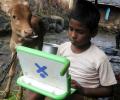
Rajeev Chandrasekhar discusses five issues pivotal for the success of Digital India

India on Wednesday asserted there can be no military solution to the lethal Syrian conflict and societies cannot be "re-ordered from outside" as people have the right to choose their own destiny.
